
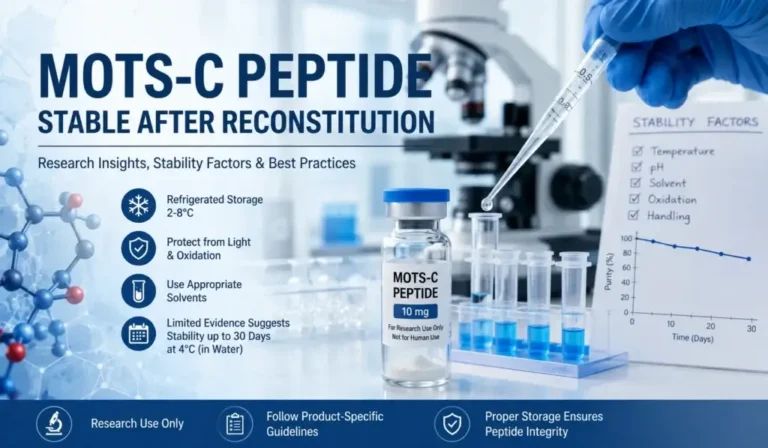
Once MOTS-c is mixed with a liquid, its stability becomes a research question. Peptides can change when exposed to heat, light, air, repeated handling or unsuitable storage. However, MOTS-c does not have one universal shelf-life that applies to every vial and solution. Current evidence suggests that some refrigerated samples may remain chemically stable for weeks, but the research is still limited.
This guide explains what researchers currently know, what remains uncertain, and which storage conditions may affect peptide integrity in controlled laboratory settings.
What Is MOTS-c Peptide Stability?
Stability means that a peptide keeps its chemical structure during storage. After reconstitution, a dry peptide becomes a liquid solution. This can make it more sensitive to temperature, oxidation, contamination, and repeated handling.
Stability does not automatically mean sterility or full biological activity. Laboratories should follow product documents and controlled methods.
How Long May MOTS-c Remain Stable After Reconstitution?
Limited research suggests that MOTS-c reconstituted in water may remain chemically stable for at least 30 days when stored at about 4°C. Researchers used high-resolution mass spectrometry to look for oxidation and degradation.
This should not be treated as a universal expiry date. The finding came from a specific laboratory setup. Different concentrations, solvents, containers, purity levels, and handling methods may give different results.
Some commercial guidance is more cautious and recommends only a few refrigerated days. The safest approach is to follow the supplier specification.
What Did the 30-Day MOTS-c Study Actually Show?
Researchers examined whether reconstituted MOTS-c in water changed over one month. They reported no significant degradation in the refrigerated sample.
However, the work did not prove that every vial remains sterile for 30 days. It also did not confirm equal biological potency in every assay. The result mainly supports chemical stability under the tested conditions.
Chemical stability, sterility, and biological activity are separate questions. A laboratory plan considers all three.
Which Factors Can Reduce MOTS-c Stability?
-
Does Temperature Matter?
Yes. Heat can speed up chemical change. Refrigeration is commonly used for short-term peptide solutions. Frozen storage may be suitable for longer periods when supported by the product guidance.
Repeated freeze-thaw cycles should be avoided because they can stress the solution. Preparing suitable research portions may reduce unnecessary temperature changes.
-
Do Light, Air, and Handling Matter?
Light and oxygen may support oxidation. Frequent opening may also raise contamination risk. Clean technique, suitable containers, limited handling and protection from light can help preserve quality.
A solution may look normal even when chemical changes are not visible.
-
Does the Reconstitution Liquid Matter?
Yes. Water, buffers, saline, and bacteriostatic preparations are not identical. The published 30-day finding concerned water, so it should not be applied to other liquids.
Use the solvent named in the product data sheet or validated laboratory method.
Is MOTS-c 10mg More Stable Than Another Vial Size?
A MOTS-c 10mg vial is not automatically more stable because of the labelled amount. Stability depends more on the final concentration, solvent, temperature, container, and handling.
Researchers planning to buy MOTS-c 10mg should review the certificate of analysis, purity data, storage instructions and batch records. The vial size should suit the study design so that the material is not repeatedly handled.
What Should Buyers Check Before Ordering Research Peptides?
People who buy peptides online should look beyond price. Reliable suppliers provide identity, purity information, batch testing, storage guidance and research-only terms.
For searches such as buy peptides UK, buy research peptides, or research peptides UK, buyers should also check local rules and delivery conditions. Alveque Peptides provides laboratory research products and should be judged by the same quality checks applied to any supplier.
How Can Researchers Get Product-Specific Guidance?
General articles cannot replace instructions for a specific batch. For MOTS-c peptide documents, handling information, or MOTS-c 10mg availability.
Products are supplied exclusively for controlled laboratory research. Researchers should follow the relevant product documents, institutional procedures and validated handling protocols.
Frequently Asked Questions –
Q. How Long Is Reconstituted MOTS-c Stable in a Refrigerator?
A. Limited evidence suggests at least 30 days in water at about 4°C under specific test conditions. Supplier guidance may be shorter, so follow the product data sheet.
Q. Can Reconstituted MOTS-c Be Kept at Room Temperature?
A. Room-temperature storage is less controlled and may increase degradation risk. Use the temperature stated in the supplier instructions.
Q. Can MOTS-c Be Frozen After Reconstitution?
A. Some suppliers permit frozen storage, but repeated freeze-thaw cycles should be avoided. Follow the batch-specific guidance.
Q. Does Bacteriostatic Water Guarantee 30-Day Stability?
A. No. The published finding used water and does not prove the same result for every bacteriostatic preparation.
Q. Where Can Laboratories Buy MOTS-c 10mg?
A. Choose a research supplier that provides purity data, batch records, and storage instructions. Alveque Peptides can provide product-specific information.
Disclaimer: This blog is educational and research information purposes only. MOTS-C peptide stability may vary depending on laboratory conditions, storage, and handling methods. It is strictly not intended for human use, animal use, medical applications, or therapeutic purposes.